← The Great Transformation

The Nature of Money

Download PDF · 9 slides

The Nature of Money
1
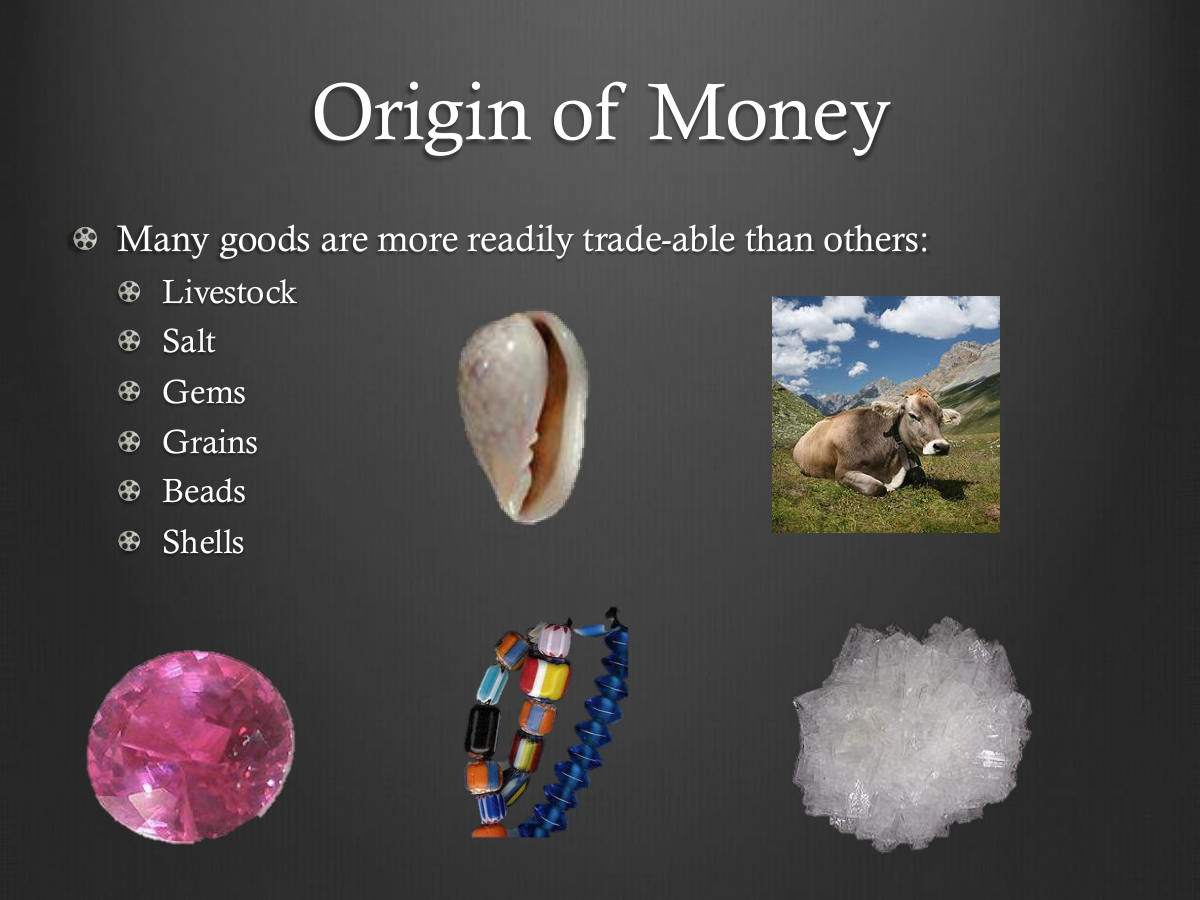
Origin of Money. Many goods are more readily trade-able than others: Livestock. Salt. Gems. Grains. Beads. Shells
2
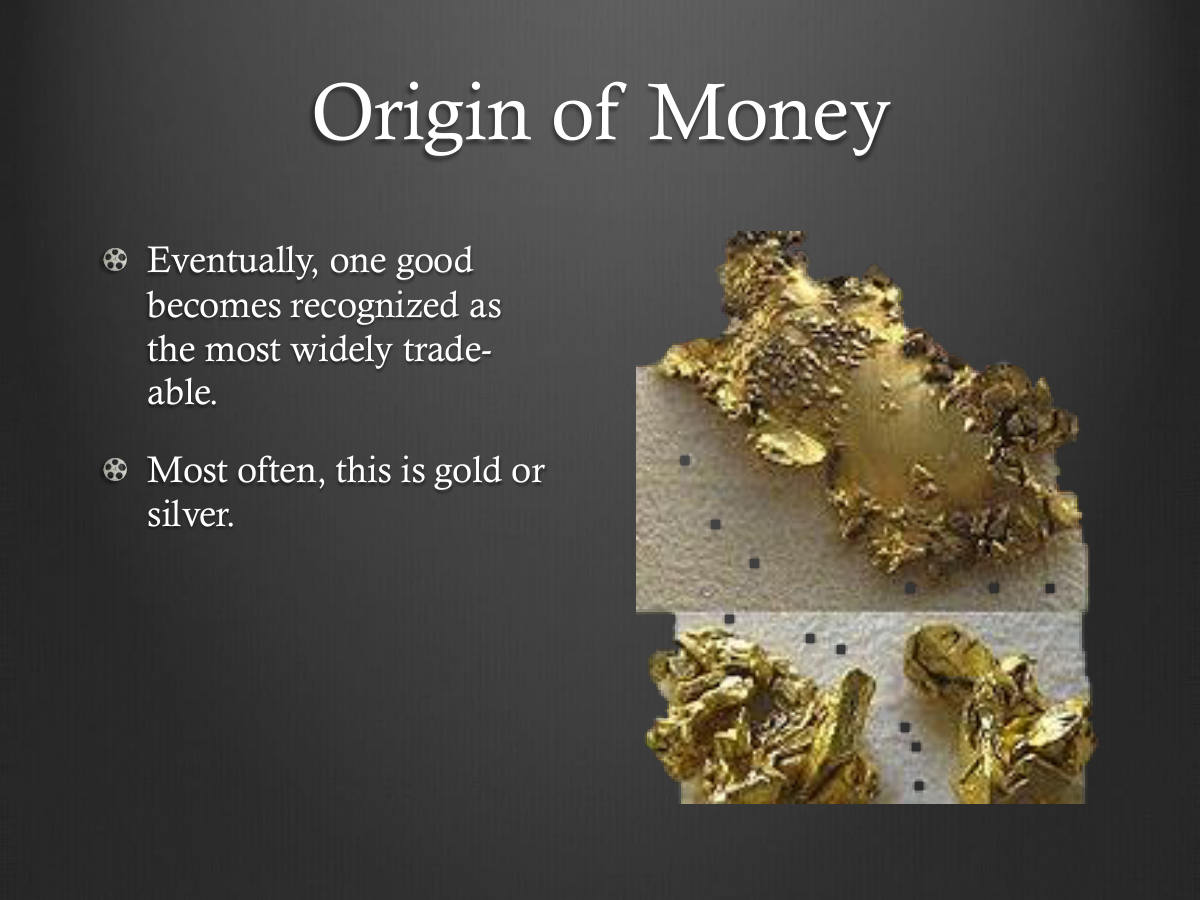
Origin of Money. Eventually, one good becomes recognized as the most widely trade-able. Most often, this is gold or silver.
3
Money Character of Goods. The good transports easily. If someone wants to trade using a commodity, it helps to be able to get the commodity to the trading site. Early instances of indirect exchange often employed livestock, especially cattle. That was money that not only talked but walked as well. Land is a poor medium of exchange because you can’t ever bring it anywhere.
4
Money Character of Goods. The good is relatively scarce. This criterion is closely tied to the one above. If the good used as money is plentiful, you’ll tend to need a lot of it to make your purchases, making it hard to move around. For instance, if we used topsoil as money, we would all need a dump truck to go grocery shopping.
5
Money Character of Goods. The good is relatively imperishable. You don’t want your money “going bad” a couple of hours or days after you get it. The longer you can hold your money, the more opportunity you have to wait for a good deal to come around. This is why items like milk, eggs, meat, and so on are not suitable as money. Live- stock can, of course, die, but you can check when you’re trading to ensure that you’re not being given money that’s on its last legs. The precious metals and gems clearly stand out in this regard.
6
Money Character of Goods. The good is easy to store. Not only should your money last, you don’t want to have to go through a lot of rigmarole to get it to last. A chemical compound that is only stable below -300 degrees Fahrenheit will not come to be used as money. Carl Menger mentions that cattle were a popular medium of exchange among people in societies that were primarily agricultural and had plenty of open land nearby. The rise of cities made cattle much less useful as money. Most co-ops have strict rules against keeping livestock in an apartment, and the practice makes it very hard to keep the shag carpet clean. The precious metals and gems are again winners here.
7
Money Character of Goods. The good is easily divisible. Not every exchange ratio will result in whole numbers of each good being exchanged. If your money is easily divisible, you can make change. Livestock clearly falls short in this regard, as once you divide it up, it’s not going to walk anywhere for you, and it becomes much more perishable. Gems are weak here also, given the difficulty in dividing them without destroying much of their value.
8
Money Character of Goods. Each unit of the good is very similar to every other unit. You don’t want to keep fussing around checking out the quality of your money and adjusting the exchange ratio based on this quality. For one thing, someone else might judge this quality differently than you do. Diamonds, while in many ways suitable as money, are problematic in this regard—it takes an expert to judge the value of any particular diamond. The divisibility problem with diamonds is related to this. You can’t get the price of a whole diamond by adding up the prices of its pieces once it is cut.
9