← The Great Transformation

The Protestant Ethic

Download PDF · 35 slides

The Protestant Ethic. And the Spirit of Capitalism
1
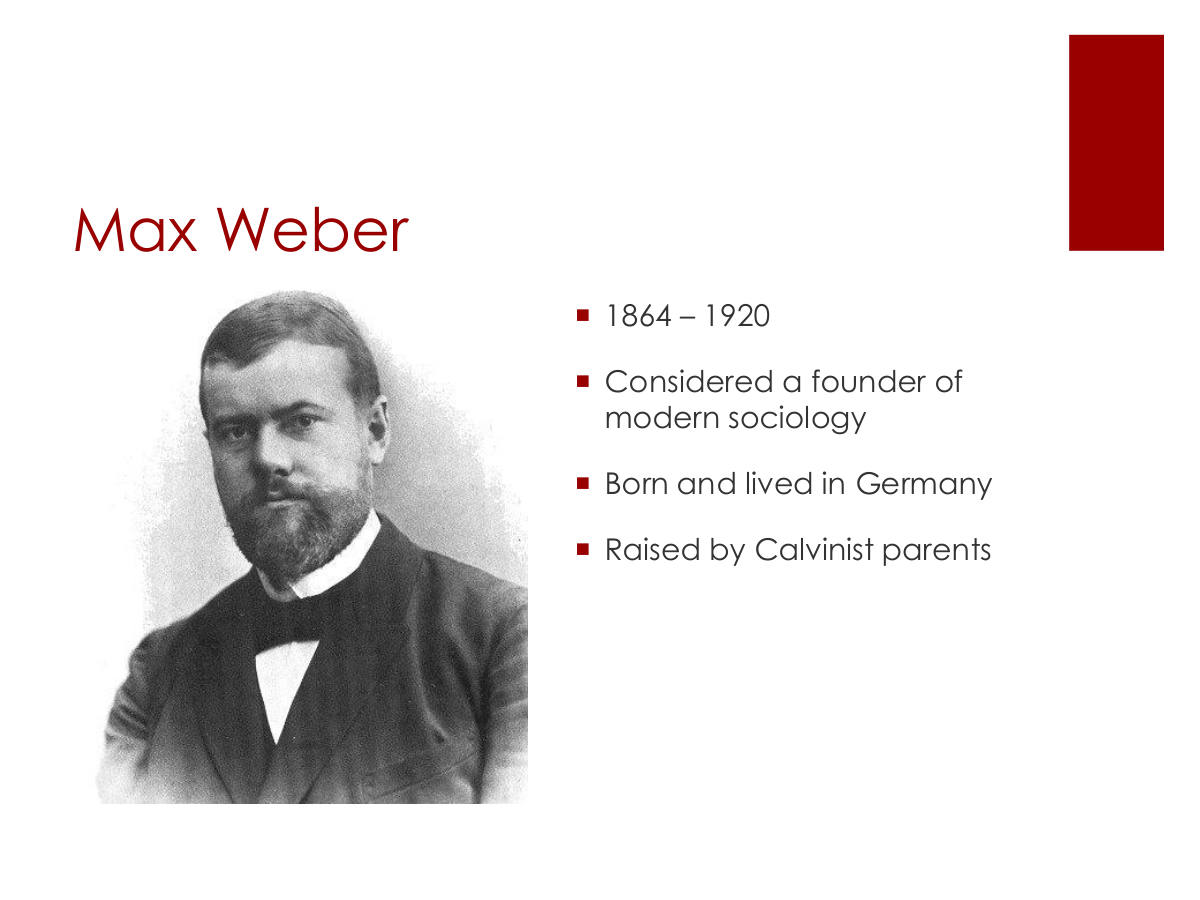
Max Weber. 1864 – 1920. Considered a founder of modern sociology. Born and lived in Germany. Raised by Calvinist parents
2
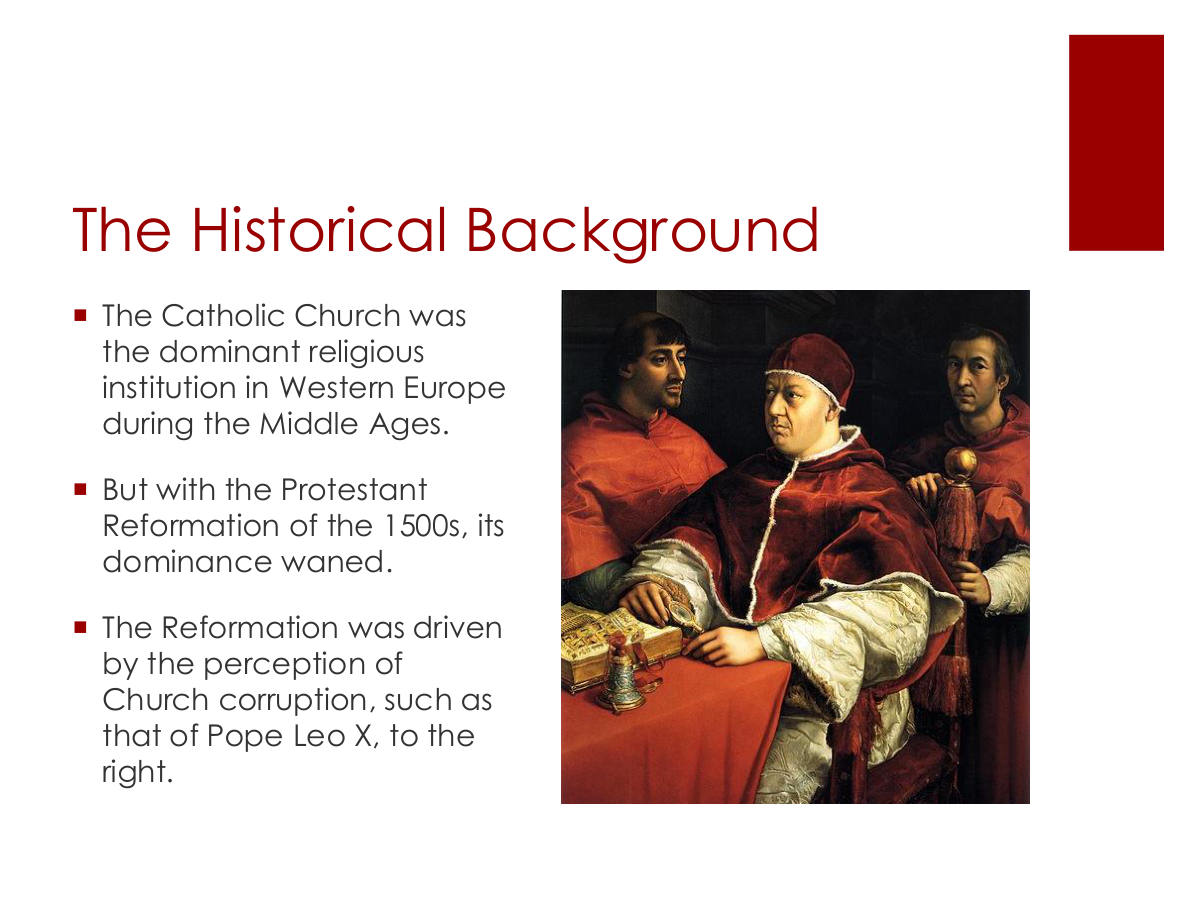
The Historical Background. The Catholic Church was the dominant religious institution in Western Europe during the Middle Ages. But with the Protestant Reformation of the 1500s, its dominance waned. The Reformation was driven by the perception of Church corruption, such as that of Pope Leo X, to the right.
3
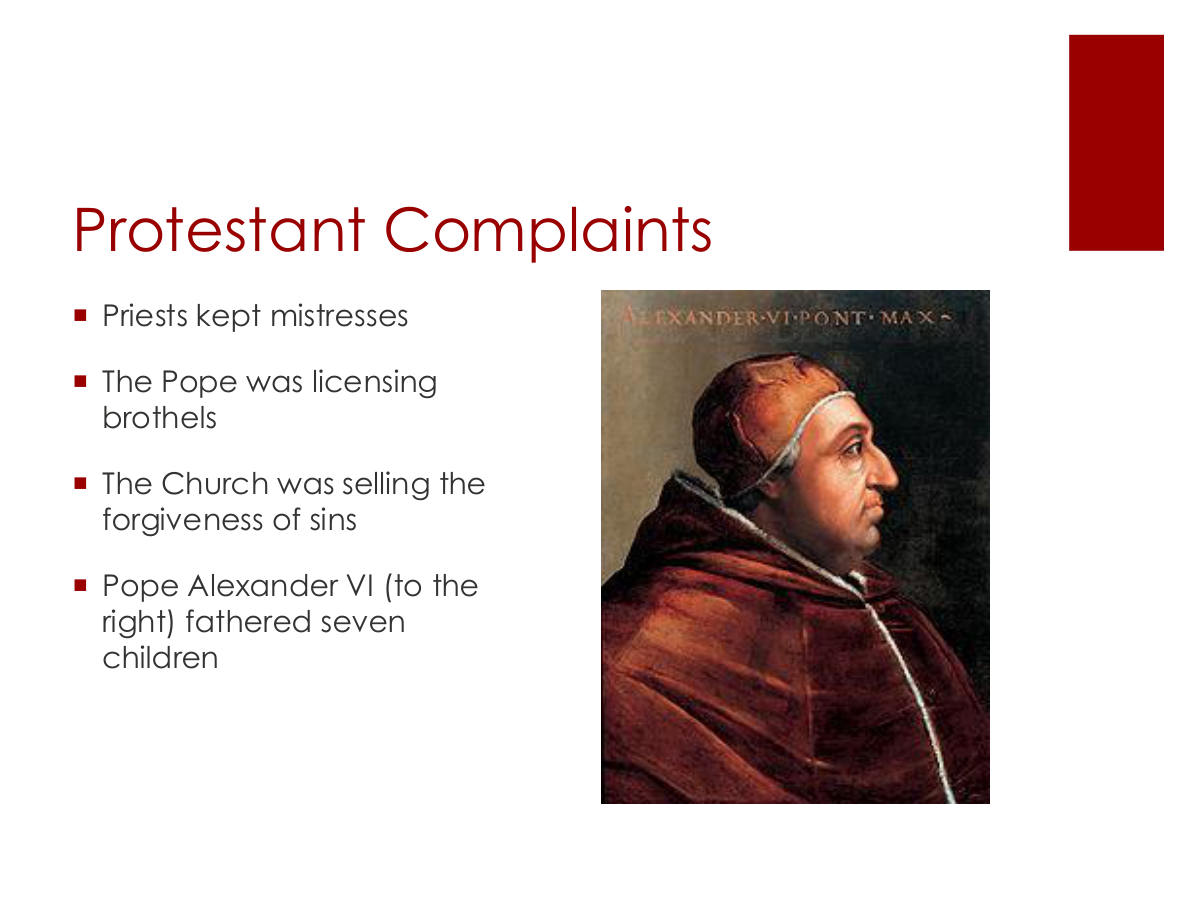
Protestant Complaints. Priests kept mistresses. The Pope was licensing brothels. The Church was selling the forgiveness of sins. Pope Alexander VI (to the right) fathered seven children
4
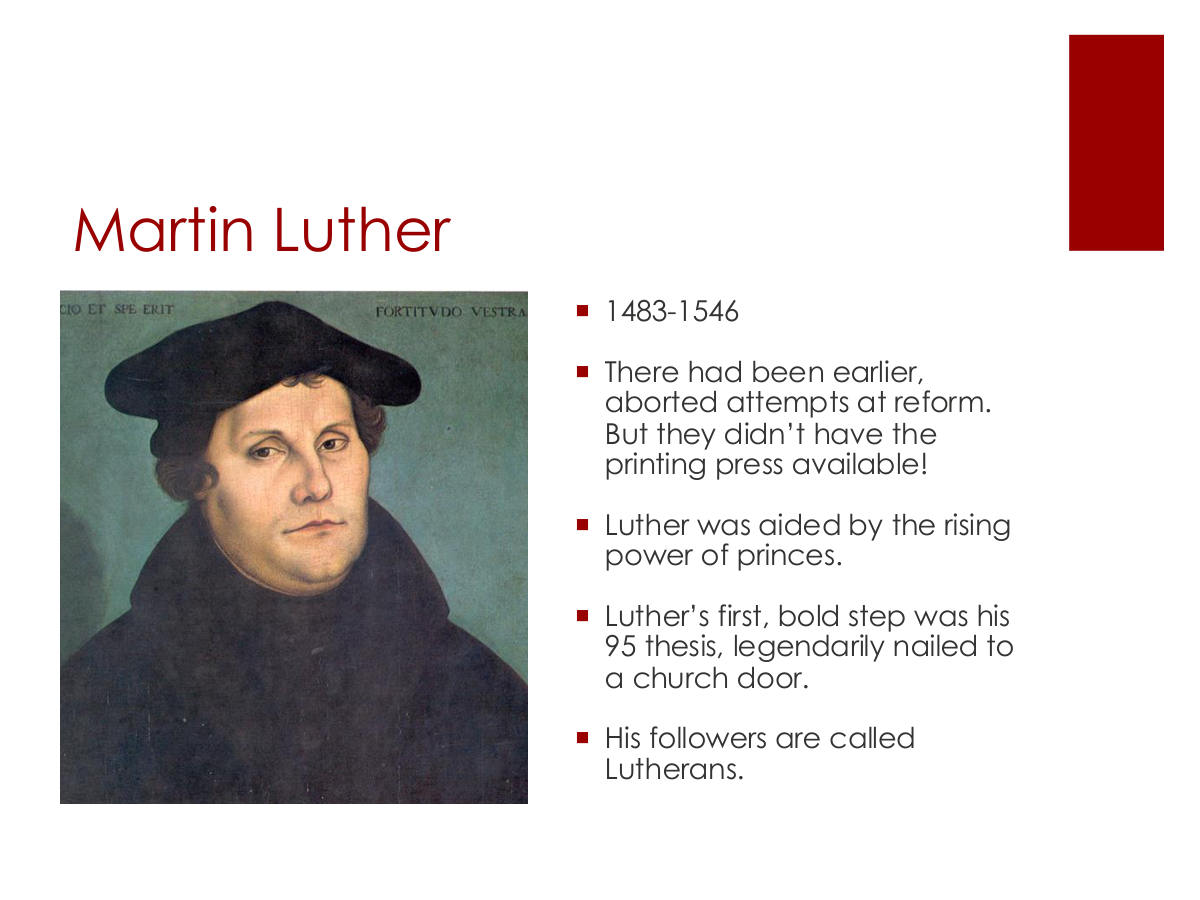
Martin Luther. 1483-1546. There had been earlier, aborted attempts at reform. But they didn’t have the printing press available! Luther was aided by the rising power of princes. Luther’s first, bold step was his 95 thesis, legendarily nailed to a church door. His followers are called Lutherans.
5
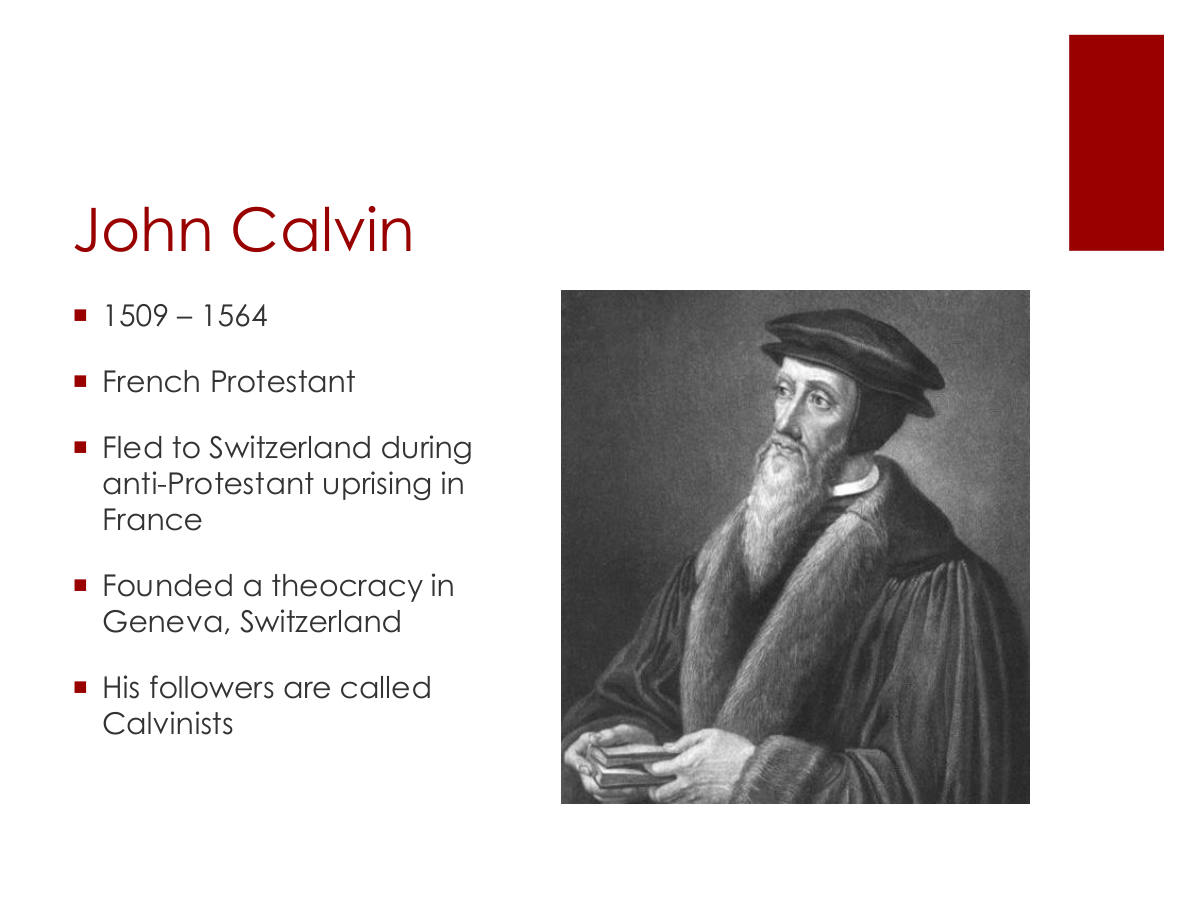
John Calvin. 1509 – 1564. French Protestant. Fled to Switzerland during anti-Protestant uprising in France. Founded a theocracy in Geneva, Switzerland. His followers are called Calvinists
6
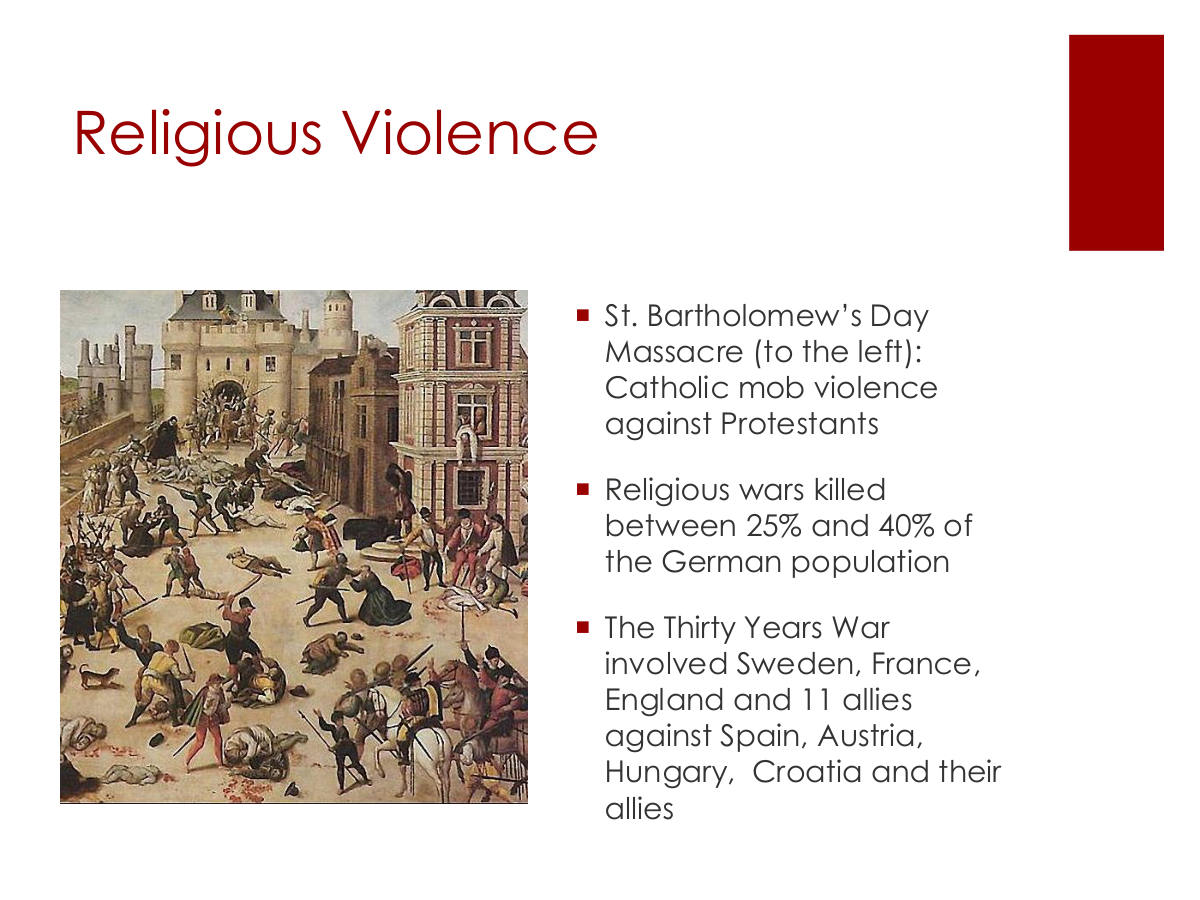
Religious Violence. St. Bartholomew’s Day Massacre (to the left): Catholic mob violence against Protestants. Religious wars killed between 25% and 40% of the German population. The Thirty Years War involved Sweden, France, England and 11 allies against Spain, Austria, Hungary, Croatia and their allies
7
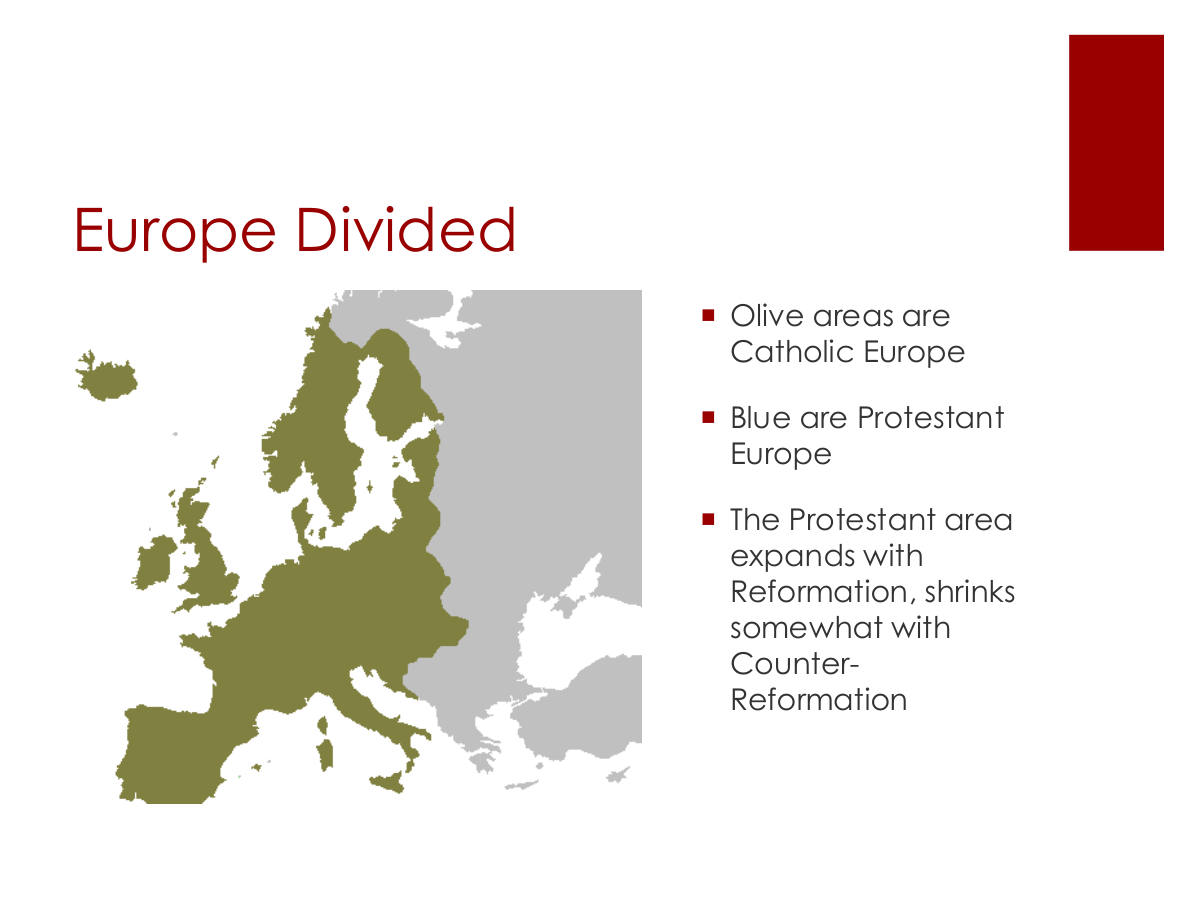
Europe Divided. Olive areas are Catholic Europe. Blue are Protestant Europe. The Protestant area expands with Reformation, shrinks somewhat with Counter-Reformation
8
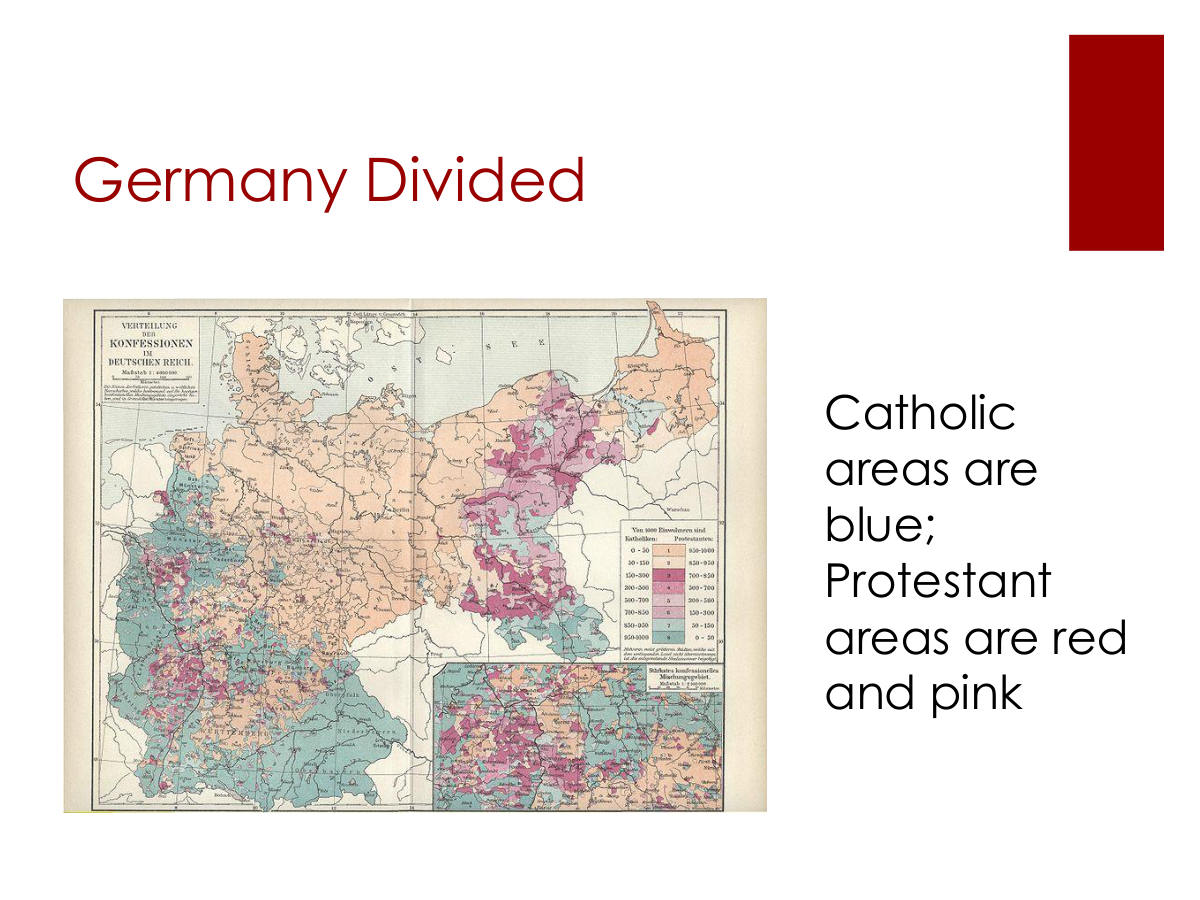
Germany Divided. Catholic areas are blue; Protestant areas are red and pink
9
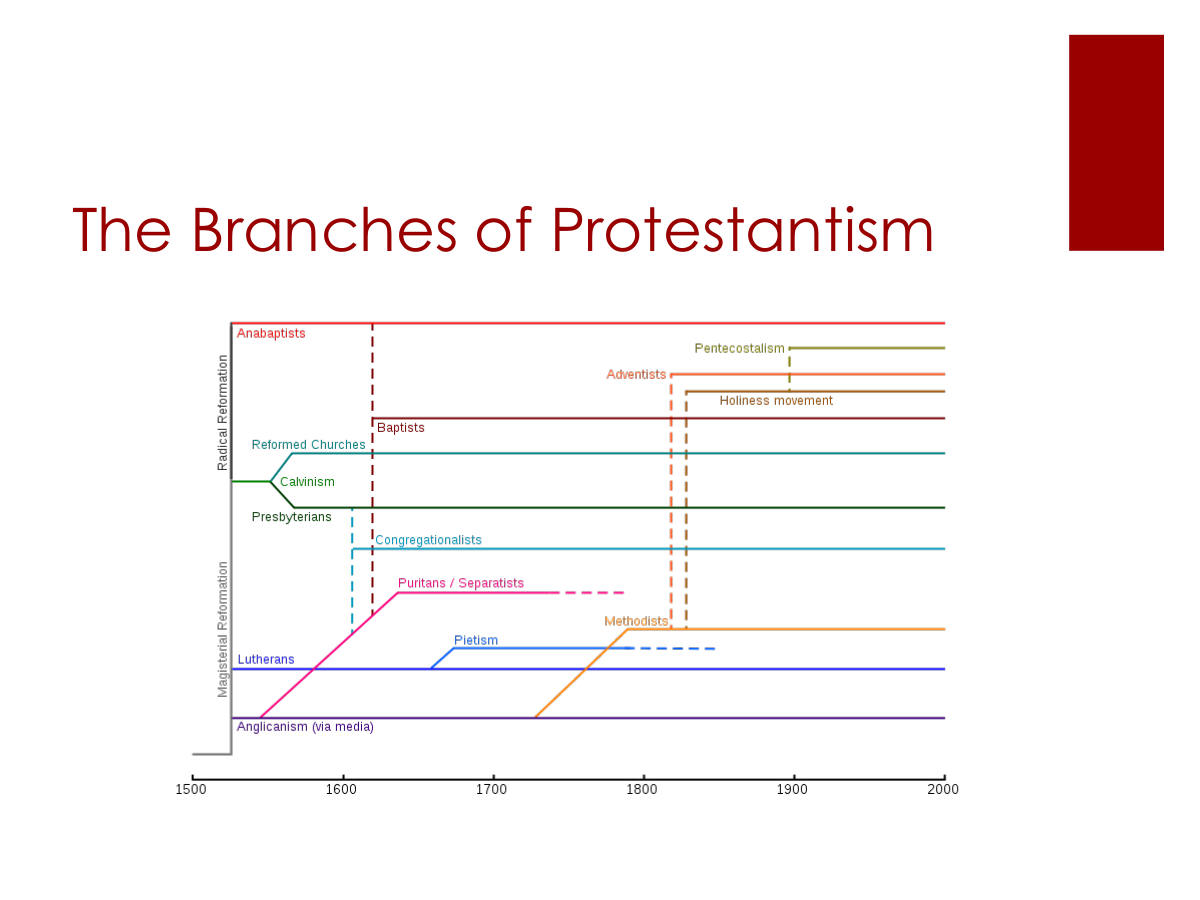
The Branches of Protestantism
10
Part One: Weber Defines His Problem
11
Weber’s Problem. “Business leaders and owners of capital, as well the skilled higher strata of the labor force… tend to be predominantly Protestant.” This holds even within one nation (Germany). Set aside the question of inherited wealth: Catholics (in Germany at that time) tend to opt for “liberal arts” educations, while Protestants attend technical and business schools. Catholics tend to remain as craftsmen (i.e., prefer guild organization) after apprenticeship, while Protestants move to factories as skilled workers (i.e., prefer capitalist organization). What accounts for this discrepancy?
12
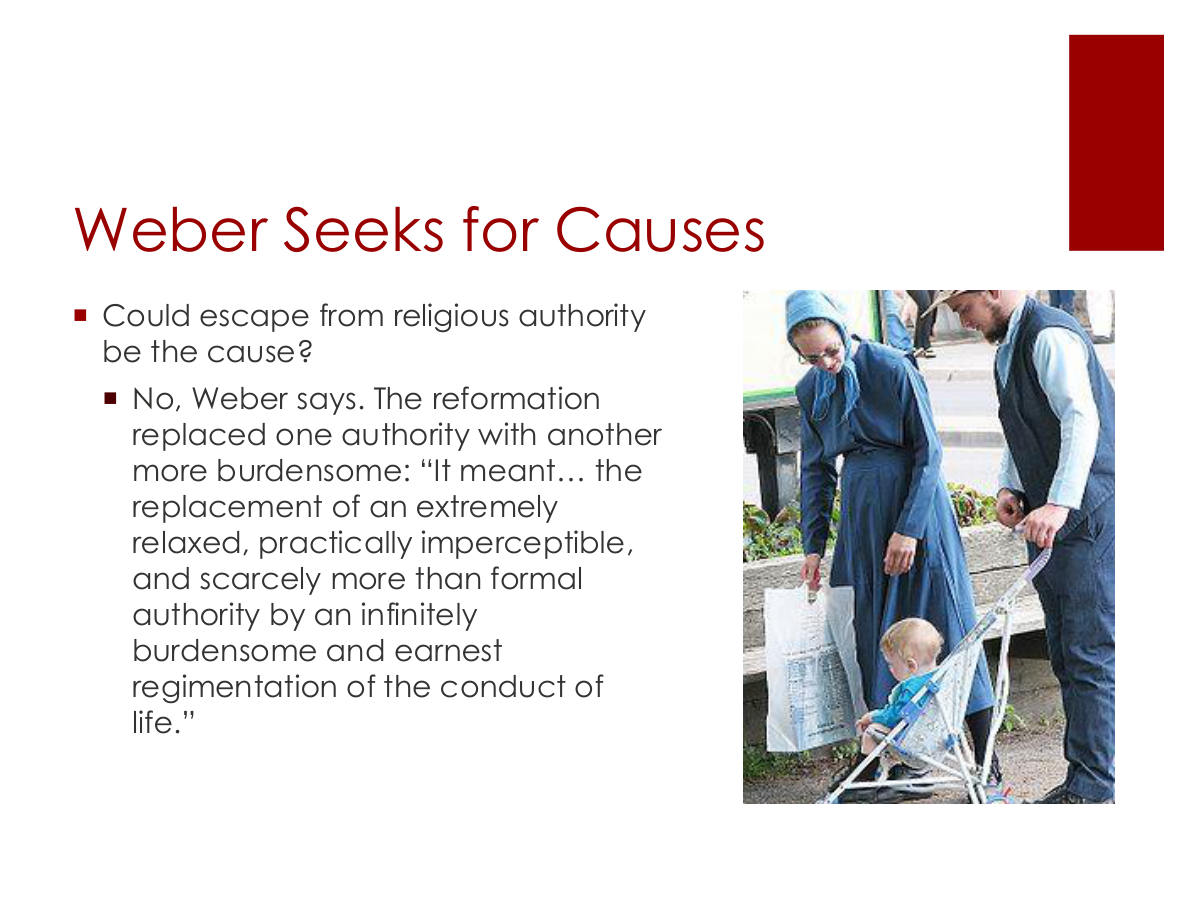
Weber Seeks for Causes. Could escape from religious authority be the cause? No, Weber says. The reformation replaced one authority with another more burdensome: “It meant… the replacement of an extremely relaxed, practically imperceptible, and scarcely more than formal authority by an infinitely burdensome and earnest regimentation of the conduct of life.”
13
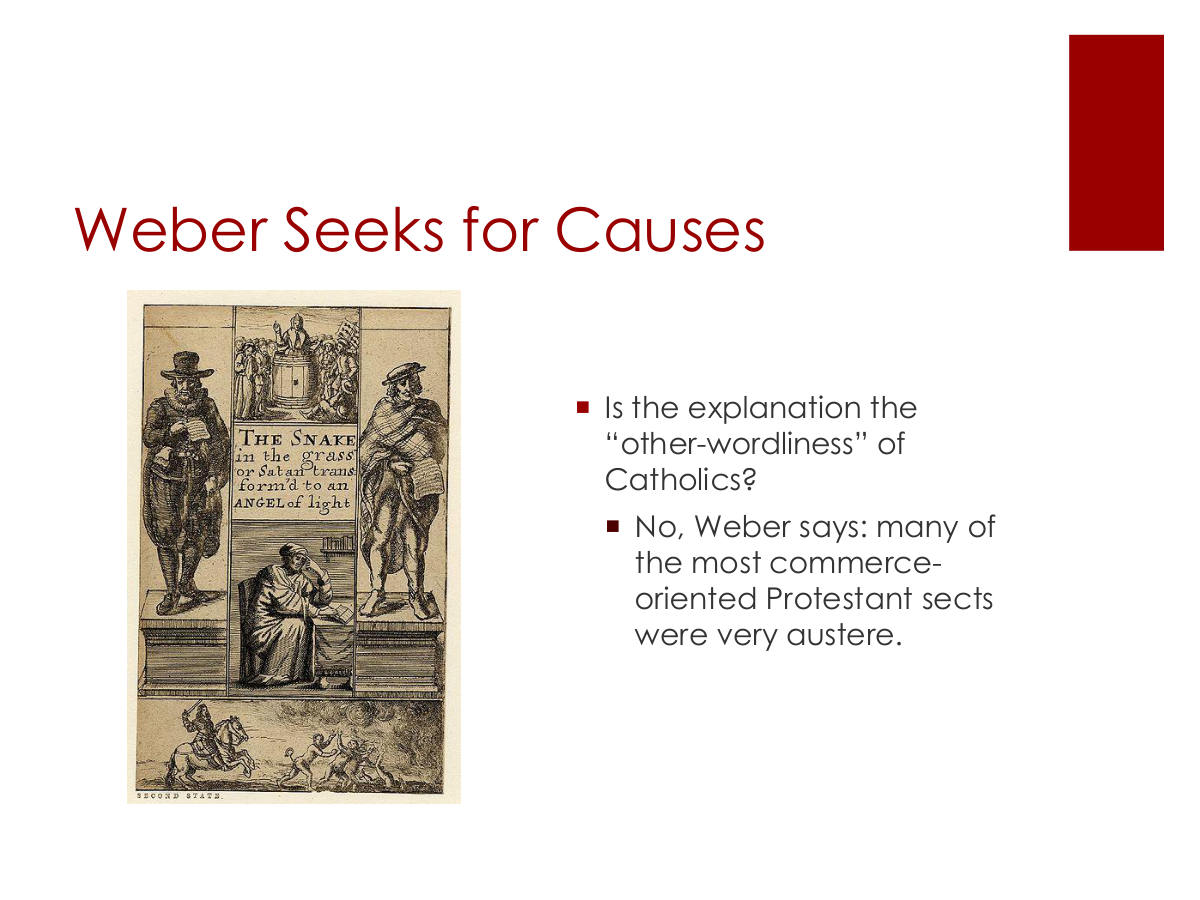
Weber Seeks for Causes. Is the explanation the “other-wordliness” of Catholics? No, Weber says: many of the most commerce-oriented Protestant sects were very austere.
14
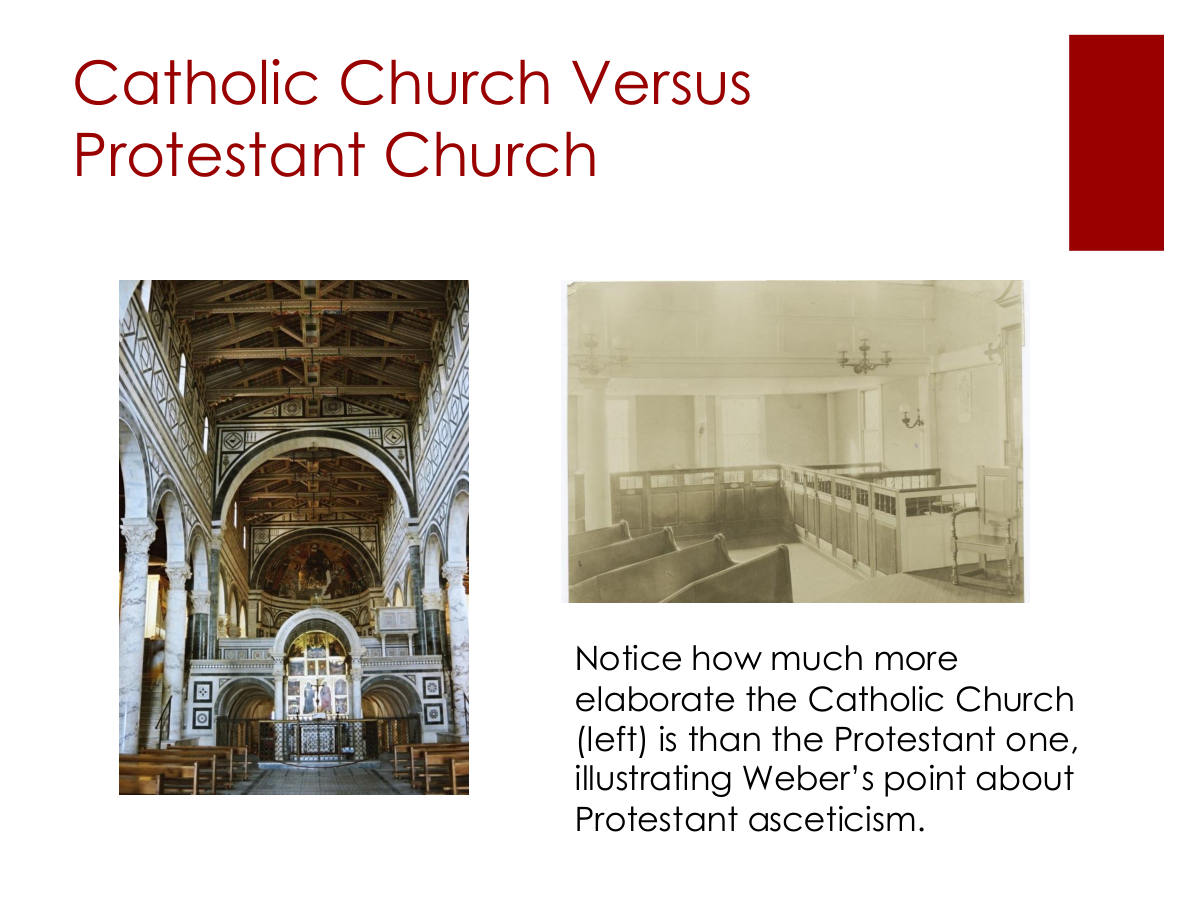
Catholic Church Versus Protestant Church. Notice how much more elaborate the Catholic Church. (left) is than the Protestant one, illustrating Weber’s point about. Protestant asceticism.
15
Weber Turns to Methodology. So what is the answer? Before proceeding, Weber pauses to discuss what a phrase like “the spirit of capitalism” means. It is the “’historical individual,’ that is, a complex of configurations in historical reality which we group together conceptually from the point of view of their cultural significance to form a single whole.” “It will not be possible to arrive at the ultimate definition of the concept at the outset but only at the conclusion of the investigation.”
16
Weber Turns to Methodology. So, we will investigate what “the spirit of capitalism” is – but that is only one focus we might have on the same events: “These ‘points of view’… are, in turn, not at all the only ones possible with which to analyze the historical phenomena we are considering. For a study different points of view, other features would be the ‘essential ones,’ as for any historical phenomenon.” These foci are concrete, not abstract: “’historical concept-formation’ does not seek to embody historical reality in abstract generic concepts but endeavors to integrate them in concrete configurations, which are always and inevitably individual in character.”
17
Part Two: Weber Examines the Spirit of Capitalism
18
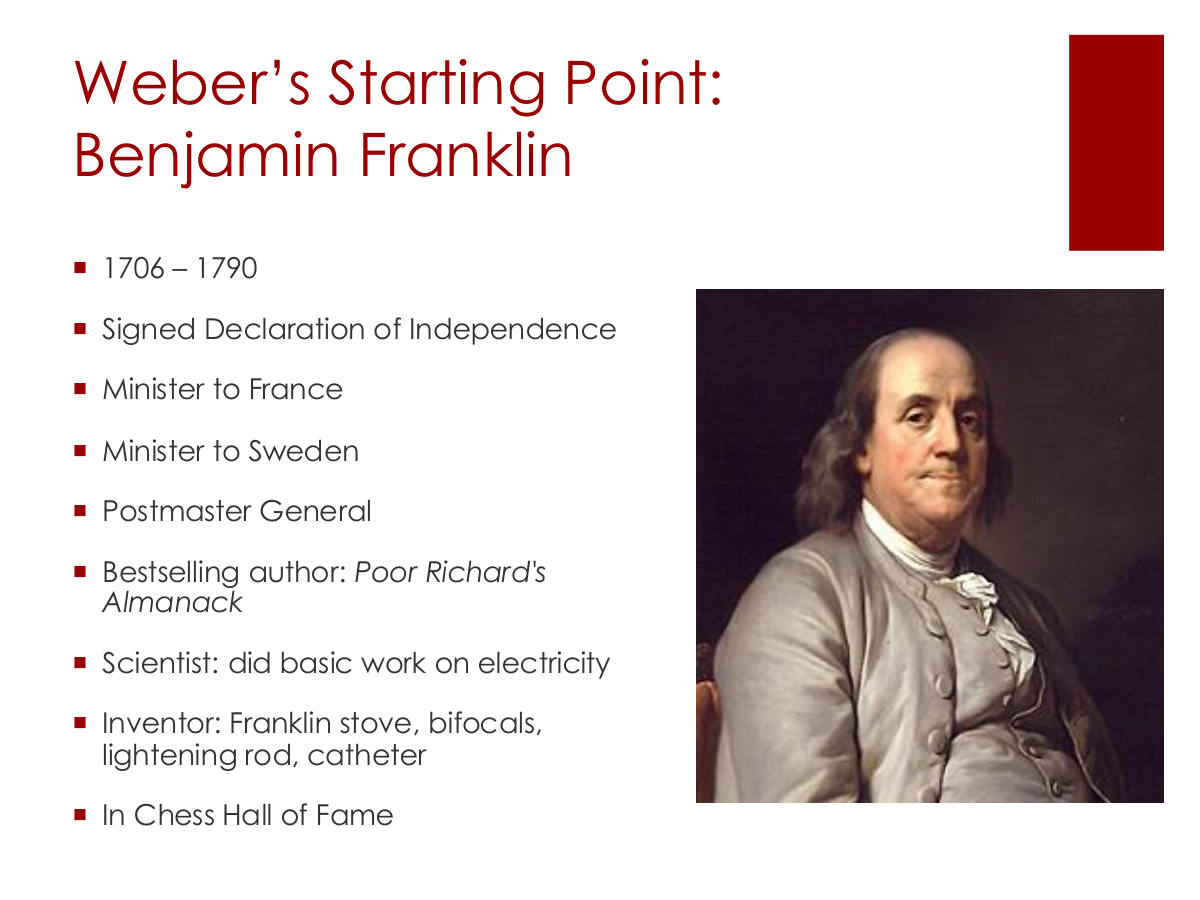
Weber’s Starting Point: Benjamin Franklin. 1706 – 1790. Signed Declaration of Independence. Minister to France. Minister to Sweden. Postmaster General. Bestselling author: Poor Richard's Almanack. Scientist: did basic work on electricity. Inventor: Franklin stove, bifocals, lightening rod, catheter. In Chess Hall of Fame
19
Franklin’s Spirit of Capitalism. “Remember, that time is money. He that can earn ten shillings a day by his labor, and goes abroad, or sits idle, one half of that day, though he spends but sixpence during his diversion or idleness, ought not to reckon that the only expense; he has really spent, rather thrown away, five shillings, besides. “Remember, that credit is money. If a man lets his money lie in my hands after it is due, he gives me interest, or so much as I can make of it during that time. This amounts to a considerable sum where a man has good and large credit, and makes good use of it.
20
Franklin’s Spirit of Capitalism. “Remember, that money is of the prolific, generating nature. Money can beget money, and its offspring can beget more, and so on. Five shillings turned is six, turned again it is seven and three pence, and so on, till it becomes a hundred pounds. The more there is of it, the more it produces every turning, so that the profits rise quicker and quicker. He that kills a breeding sow, destroys all her offspring to the thousandth generation. He that murders a crown, destroys all that it might have produced, even scores of pounds.”
21
Franklin’s Spirit of Capitalism. “For six pounds a year you may have the use of one hundred pounds, provided you are a man of known prudence and honesty. “He that spends a groat* a day idly, spends idly above six pounds a year, which is the price for the use of one hundred pounds. “He that wastes idly a groat’s worth of his time per day, one day with another, wastes the privilege of using one hundred pounds each day. “He that idly loses five shillings’ worth of time, loses five shillings, and might as prudently throw five shillings into the sea. “He that loses five shillings, not only loses that sum, but all the advantage that might be made by turning it in dealing, which by the time that a young man becomes old, will amount to a considerable sum of money.” * groat: an English coin worth four pennies
22
Weber on Franklin. “In fact, the summum bonum* of his ethic, the earning of more and more money, combined with the strict avoidance of all spontaneous enjoyment of life, is above all completely devoid of any… hedonistic** admixture. It is thought of so purely as an end in itself, that from the point of view of the happiness of, or utility to, the single individual, it appears entirely transcendental and absolutely irrational. Man is dominated by the making of money, by acquisition as the ultimate purpose of his life. Economic acquisition is no longer subordinated to man as the means for the satisfaction of his material needs.” * -- highest good, a phrase Aquinas uses. ** -- pleasure-seeking
23
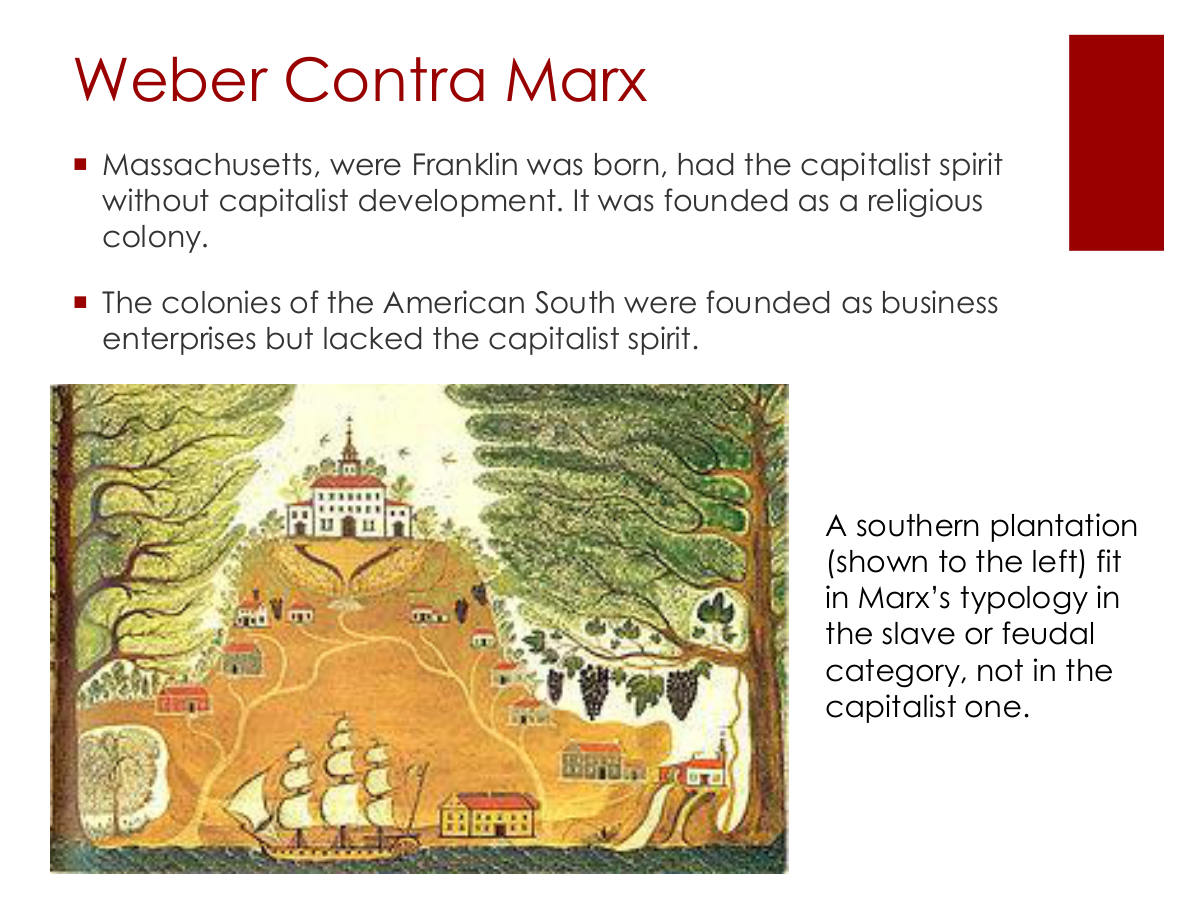
Weber Contra Marx. Massachusetts, were Franklin was born, had the capitalist spirit without capitalist development. It was founded as a religious colony. The colonies of the American South were founded as business enterprises but lacked the capitalist spirit. A southern plantation. (shown to the left) fit in Marx’s typology in the slave or feudal category, not in the capitalist one.
24
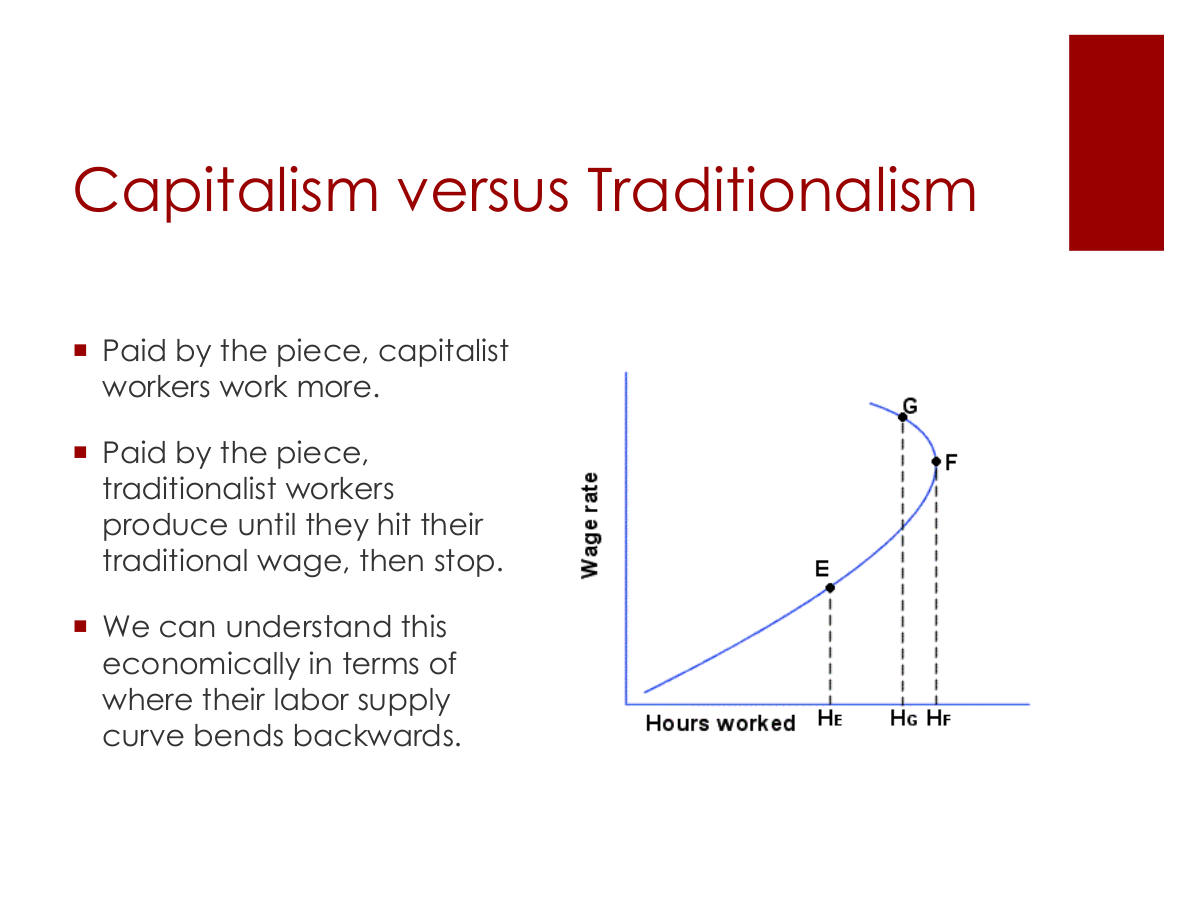
Capitalism versus Traditionalism. Paid by the piece, capitalist workers work more. Paid by the piece, traditionalist workers produce until they hit their traditional wage, then stop. We can understand this economically in terms of where their labor supply curve bends backwards.
25
Capitalism versus Traditionalism. “[The traditional worker] did not ask: how much can I earn in a day if I do as much work as possible? but: how much must I work in order to earn the wage, 2½ marks, which I earned before and which takes care of my traditional needs? This is an example of what is here meant by traditionalism. A man does not “by nature” wish to cam more and more money, but simply to live as he is accustomed to live and to earn as much as is necessary for that purpose. Wherever modern capitalism has begun its work of increasing the productivity of human labor by increasing its intensity, it has encountered the immensely stubborn resistance of this leading trait of pre-capitalistic labor.”
26
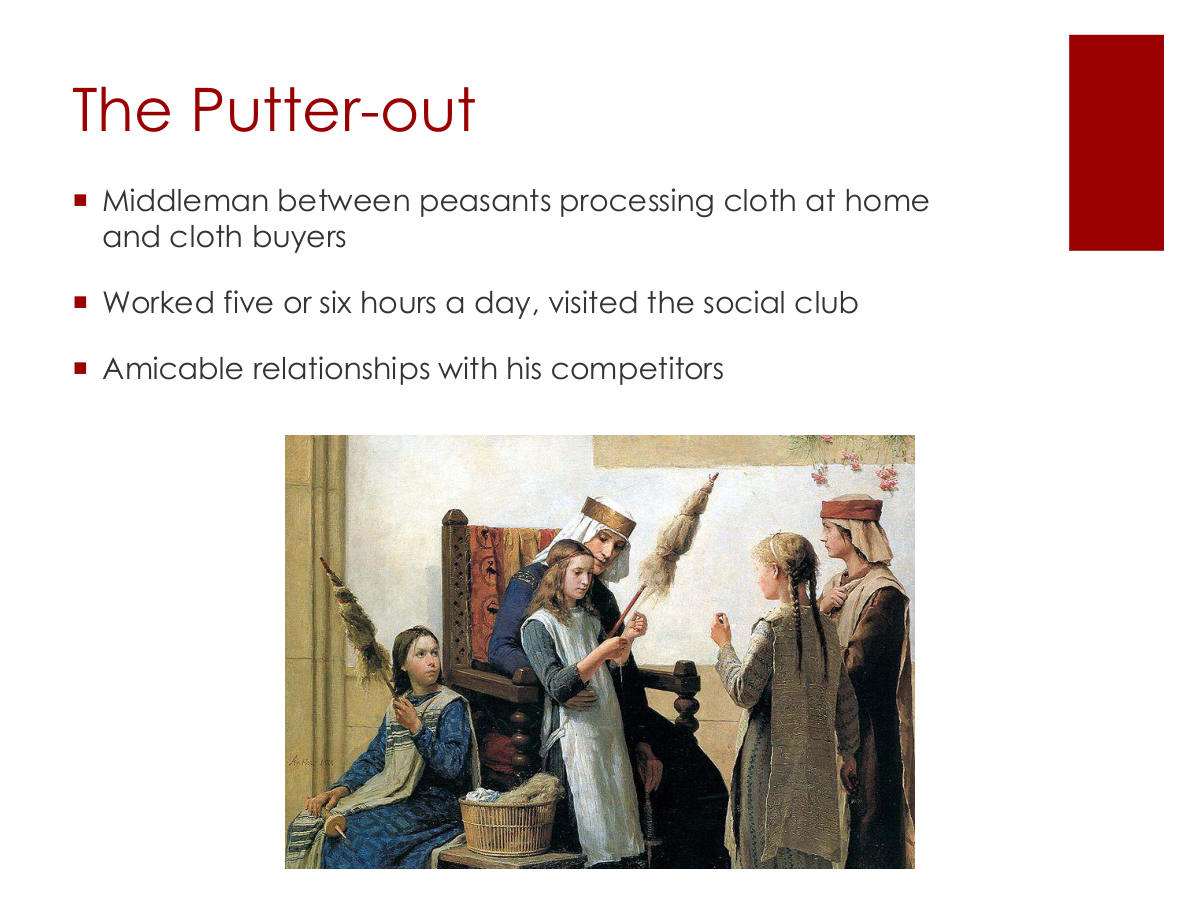
The Putter-out. Middleman between peasants processing cloth at home and cloth buyers. Worked five or six hours a day, visited the social club. Amicable relationships with his competitors
27
What Happened? “Now at some time this leisureliness was suddenly destroyed, and often entirely without any essential change in the form of organization, such as the transition to a unified factory, to mechanical weaving, etc. What happened was, on the contrary, often no more than this: some young man from one of the putting-out families went out into the country, carefully chose weavers for his employ, greatly increased the rigor of his supervision of their work, and thus turned them from peasants into laborers. On the other hand, he would begin to change his marketing methods by so far as possible going directly to the final consumer, would take the details into his own hands, would personally solicit customers, visiting them every year, and above all would adapt the quality of the product directly to their needs and wishes. At the same time he began to introduce the principle of low prices and large turnover… those who would not follow suit had to go out of business.”
28
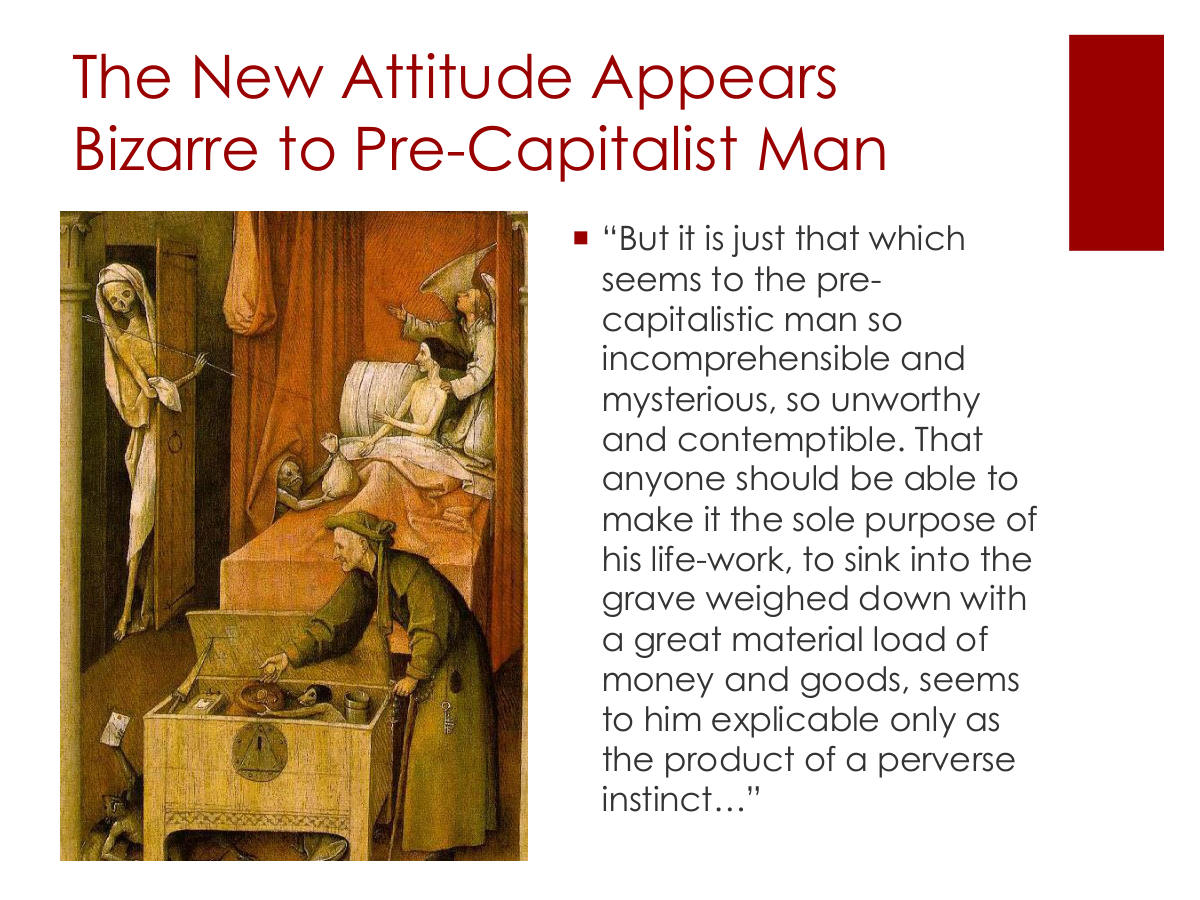
The New Attitude Appears Bizarre to Pre-Capitalist Man. “But it is just that which seems to the pre-capitalistic man so incomprehensible and mysterious, so unworthy and contemptible. That anyone should be able to make it the sole purpose of his life-work, to sink into the grave weighed down with a great material load of money and goods, seems to him explicable only as the product of a perverse instinct…”
29
Part Three: Weber Traces the New Attitude to Protestantism
30
How Did This New Attitude Arise? Martin Luther and the idea of the “calling”: “The monastic life is not only quite devoid of value as a means of justification before God, but he also looks upon its renunciation of the duties of this world as the product of selfishness, withdrawing from temporal obligations. In contrast, labor in a calling appears to him as the outward expression of brotherly love.” “the fulfillment of worldly duties is under all circumstances the only way to live acceptably to God. It and it alone is the will of God, and hence every legitimate calling has exactly the same worth in the sight of God.”
31
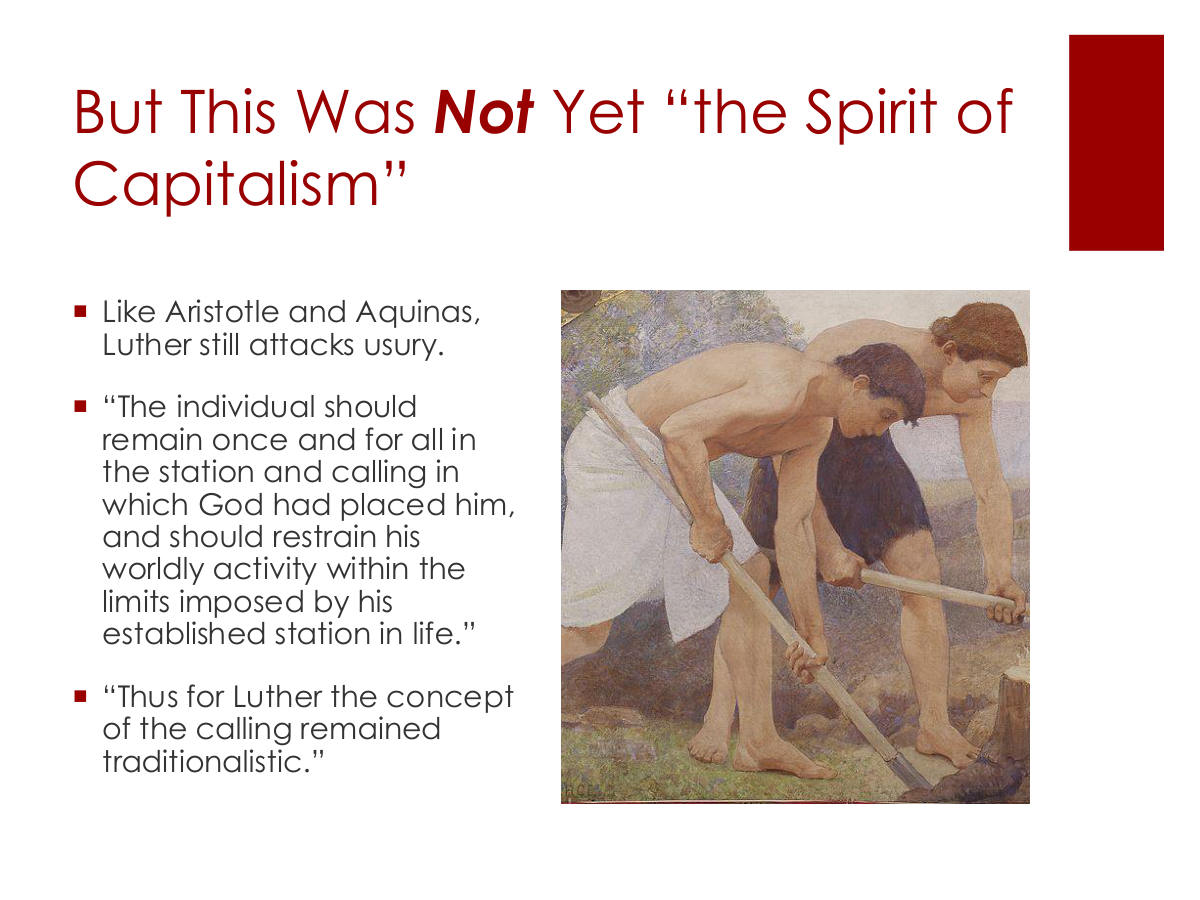
But This Was Not Yet “the Spirit of Capitalism” Like Aristotle and Aquinas, Luther still attacks usury. “The individual should remain once and for all in the station and calling in which God had placed him, and should restrain his worldly activity within the limits imposed by his established station in life.” “Thus for Luther the concept of the calling remained traditionalistic.”
32
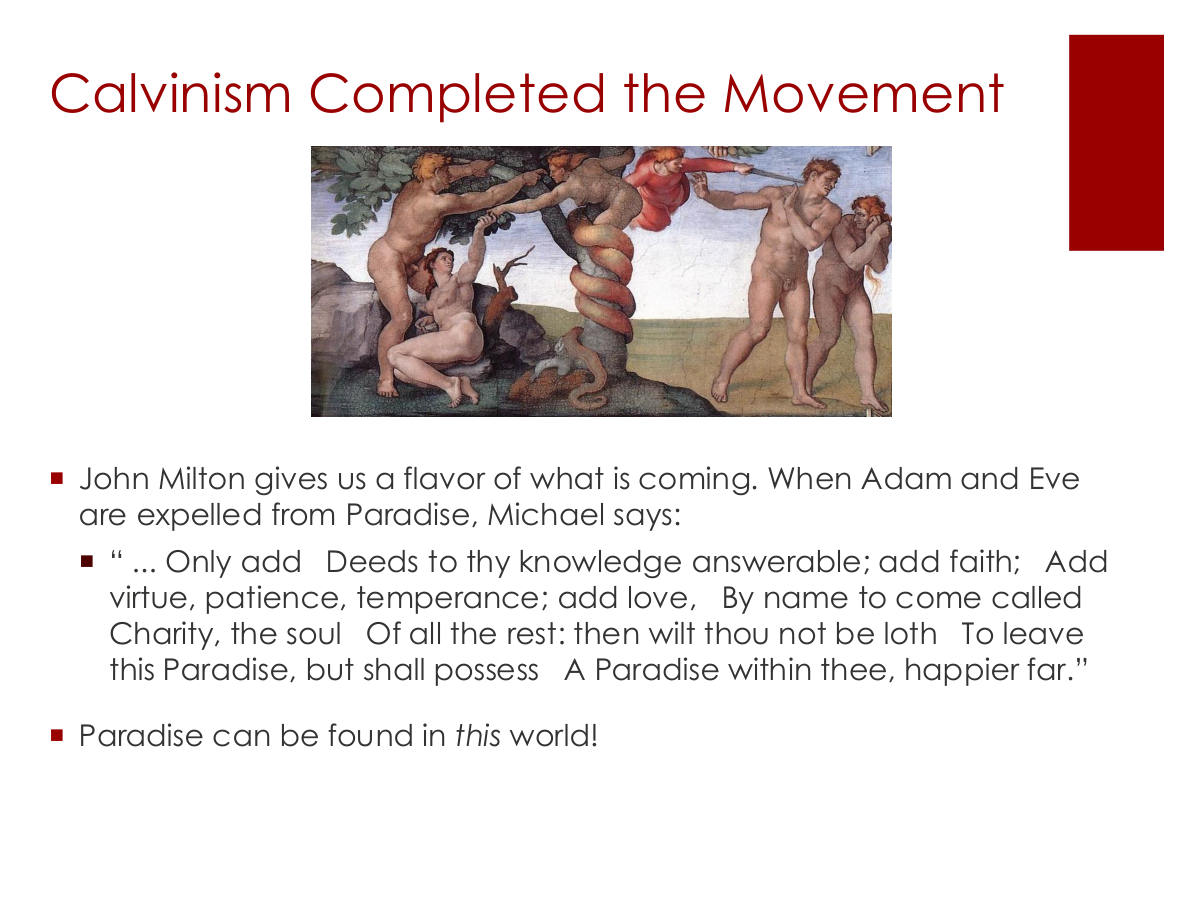
Calvinism Completed the Movement. John Milton gives us a flavor of what is coming. When Adam and Eve are expelled from Paradise, Michael says: “ ... Only add Deeds to thy knowledge answerable; add faith; Add virtue, patience, temperance; add love, By name to come called Charity, the soul Of all the rest: then wilt thou not be loth To leave this Paradise, but shall possess A Paradise within thee, happier far.” Paradise can be found in this world!
33
Weber Does Not Mean That Protestants Intended Capitalism. “The salvation of the soul… alone was the center of their life and work. Their ethical ideals and the practical results of their doctrines were all based on that alone… We shall thus have to admit that the cultural consequences of the Reformation were to a great extent, perhaps in the particular aspects with which we are dealing predominantly, unforeseen and even unwished-for results of the labors of the reformers. They were often far removed from or even in contradiction to all that they themselves thought to attain.”
34
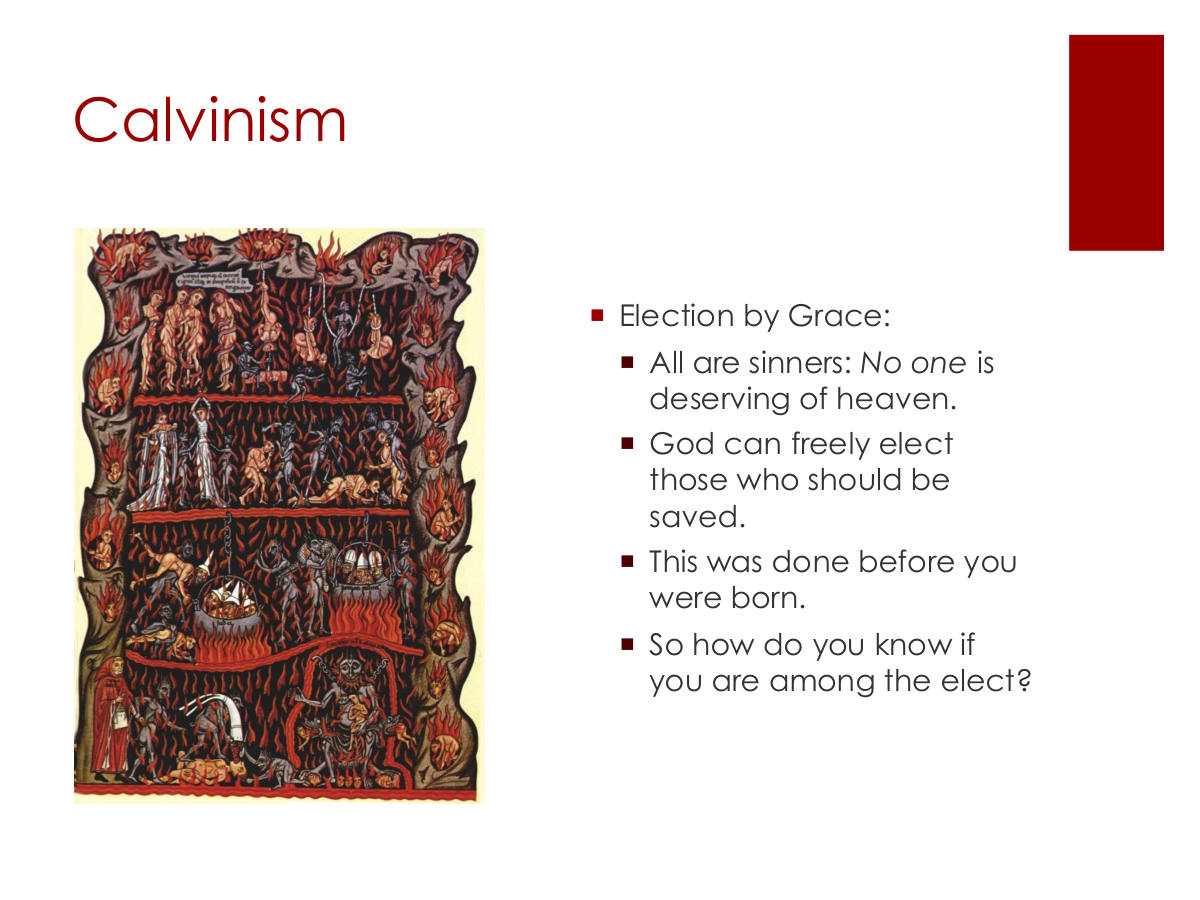
Calvinism. Election by Grace: All are sinners: No one is deserving of heaven. God can freely elect those who should be saved. This was done before you were born. So how do you know if you are among the elect?
35