Macroeconomics Final
Name ________________________________________________
40 multiple choice, 2 points each.
1) Macroeconomics primarily involves the study of:
a) individual firms
b) choices individuals make about consumption
c) very large products, such as giant airplanes and Big Gulp sodas
d) the national and global economy
2) In economics, inflation generally means:
a) a rise in the price of many or most goods
b) a decline in many or most prices
c) the process by which dirigibles and whatnot are inflated
d) an increase in unemployment
3) In making economic decisions, we may have to trade off rising living standards at present against:
a) sustainability
b) inflation
c) productivity
d) unemployment
4) Government stimulus spending during a recession would be recommended by:
a) Say's Law
b) classical economics
c) Keynesian economics
d) Adam Smith
5) "Economic development" refers to:
a) the creation of better economic theories
b) classical economics
c) hitting the lotto and getting rich
d) a nation moving from poverty to greater wealth
Consider a one good economy, where bananas are produced and traded for money. Here are three years of economic data:
Output Price / banana Total sales
Year 1 100 ban. $1 $100
Year 2 100 ban. $2 $200
Year 3 200 ban. $2 $400
6) From Year 1 to Year 2, we saw:
a) real growth but no nominal growth
b) nominal growth but no real growth
c) deflation
d) both real and nominal growth
7) From Year 2 to Year 3, we saw:
a) real growth but no nominal growth
b) nominal growth but no real growth
c) deflation
d) both real and nominal growth
8) If I calculate the relationship of average unemployment per year to total industrial output for the year, that would be:
a) a theoretical investigation
b) an historical study
c) an empirical study
d) laissez faire
9) The Production-Possibilities Frontier (PPF) might move outward over time due to:
a) workers desiring more leisure
b) an earthquake that destroyed several factories
c) a breakthrough computer chip that makes processing much faster
d) all of the above
10) Ceteris paribus, a surplus of a good causes:
a) the price to drop
b) the demand curve to shift leftward
c) suppliers to produce more of the good
d) perfect competition
11) Suppose there is a decrease in the supply of lumber. What would we expect to happen to the equilibrium price and quantity of lumber?
a) Price and quantity will both rise.
b) Price and quantity will both fall.
c) Price will rise, quantity will fall.
d) Price will fall, quantity will rise.
12) We could fall back inside the Production-Possibilities Frontier due to:
a) Technological progress
b) An economic downturn
c) An earthquake that destroys a factory
d) A more efficient use of resources
13) What type of unemployment would prevent the unemployment from falling to zero, even in a very good job market?
a) Structural unemployment
b) Frictional unemployment
c) Recessionary unemployment
d) Cyclical unemployment
e) Efficiency unemployment
14) In spending their income, consumers must choose between:
a) buying new factory equipment or paying workers more
b) spending more on marketing or business computers
c) consumption and investment
d) all of the above
15) An economic system is most likely to be sustainable if:
a) it is using up the available natural resources quickly
b) people are carefully planning for the future
c) there is an emphasis on short-term profits
d) people live for the moment
16) According to the Classical labor market model, a minimum wage above the equilibrium wage will result in …
a) an increase in unemployment
b) an increase in employment
c) no change in employment
d) an increase in the size of the labor force
e) a decrease in the number of discouraged workers
17) The term used to refer to fluctuations in the level of national production is …
a) the inflation cycle.
b) the stock market cycle.
c) the sustainability cycle.
d) the living standards cycle.
e) the business cycle.
18) If buyers purchase less of a good in response to a change in price, that is called:
a) a drop in demand
b) a change in quantity demanded
c) a demand curve
d) all of the above
19) A decrease in supply is when:
a) the supply curve shifts to the left
b) the price of a good drops
c) the price of a good goes up
d) the supply curve shifts to the right
20) An example of a good typically thought to have a relatively INelastic demand is:
a) macaroni
b) heroin
c) cotton shirts
d) all of the above
21) What is Say’s Law?
a) Reducing unemployment leads to increased inflation.
b) There’s no such thing as a free lunch.
c) Supply creates its own demand.
d) Demand creates its own supply.
e) The growth of the money supply should be constant.
22) If nominal GDP stays the same while the price level drops by half, real GDP:
a) has doubled
b) has remained constant
c) has gone up by a factor of four
d) can’t answer; too little information
23) Two major contributors to our well-being that are left out of GDP are:
a) factory production and car sales
b) shoe manufacturing and toothpaste
c) purchases of televisions and DVD players
d) the environment and domestic (in the home) production
24) Consider the following PPF which illustrates the potential grades Bill could get on his biology and economics tests based on how much time he devotes to studying each subject:
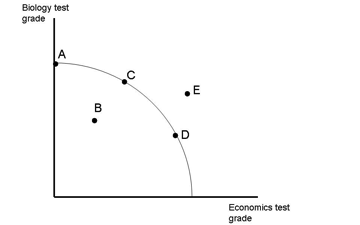
Which one of the following statements is FALSE?
If Miguel devotes all his available time to studying biology, he will end up at point A.
Miguel can not reach point E with his available resources.
Point B can be interpreted as an inefficient outcome.
Point D is more efficient than point A.
Points C and D can both be considered efficient.
25) One reason certain important things are left out of the measure of GDP is:
a) economists are embarrassed to talk about sex
b) car sales are not considered “real” economic activity
c) environmental issues and domestic production are hard to measure
d) shoes are beneath economists
26) In the classical framework, if unemployment is too high, the solution is for:
a) oil prices to fall
b) wages to fall
c) inflation to drop
d) the government to pass a stimulus package
27) In the Keynesian framework, if investment drops:
a) everyone will find employment
b) employment will drop as well
c) prices will rise
d) inflation will skyrocket
28) An example of cyclical unemployment is:
a) the economy crashes, and millions lose their jobs
b) someone switches careers and is looking for a job in his/her new field
c) someone loses their job because they slipped on the ice due to a lack of friction
d) cycles go out of style and are replaced by Segways
29) An example of frictional unemployment is when:
a) the economy crashes, creating lots of friction, and millions lose their jobs
b) someone switches careers and is looking for a job in his/her new field
c) someone loses their job because they slipped on the ice due to a lack of friction
d) typewriters are replaced by computers, causing job losses among typewriter mechanics
30) An example of structural unemployment is when:
a) the economy crashes and millions lose their jobs
b) a housewife enters the labor force and spends time finding her first job
c) record players are replaced by MP3 players, causing job losses among record player mechanics
d) someone slips on the ice, causing structural damage, and they lose their job
31) If during a recession, the government spends an additional $200 billion, but we see a boost to output (Y) of $600 billion, Keynesian theory would attribute that to:
a) the divider
b) a multiplier of six
c) lower interest rates
d) a multiplier of three
e) an intended investment boost of $400 billion
32) If an average dollar was spent eight times last year, but four times this year, we would say:
a) the velocity of money has increased
b) real output has increased
c) this was because of the multiplier
d) the velocity of money has decreased
33) In terms of the quantity equation MV = PY, Monetarists and New
Keynesians chiefly differ over:
a) how to measure M
b) whether an increase in Y is good
c) how likely V is to undergo rapid change
d) whether that 'P' really belongs there
34) Intended investment falls and the economy slumps. If Scott Sumner says the Fed should lower interest rates, he is calling for ________________ to help end the recession.
a) fiscal policy
b) monetary policy
c) austerity
d) tight money
35) In the Keynesian cross model, if the Fed "cuts interest rates," the goal is to:
a) slow consumer spending
b) increase intended investment
c) reduce intended investment
d) stop runaway inflation
e) mess with investors' heads
36) In the classical market for loanable funds, what would make the interest rate rise?
a) people suddenly start to save more
b) businesses desperately need cash for new investment projects
c) businesses see no hope for future investment
d) nothing
37) In a hyperinflation, in terms of the quantity equation, we might expect:
a) M and V to move in opposite direction
b) Y to soar
c) M and V to both increase
d) M to head towards zero
38) Consider the quantity equation, MV = PY, with a one good economy. If in that economy there are 1000 one dollar coins (the only money!), 1000 bananas output and purchased, and each banana costs $4, what is the value of V?
a) 1
b) 3
c) 4
d) 8
e) 16
39) In the Keynesian cross model, increased government spending (G) in a recession is intended to make up for:
a) a rise in inflation
b) a drop in intended investment
c) a drop in savings
d) too much consumer spending
40) In Hayek’s model, the chief culprit explaining a downturn is:
a) interest rates that are held artificially low
b) a lack of government spending
c) the “animal spirits” of investors getting spooked
d) a collapse in consumer demand
Two problems, 20 points altogether.
1) Carefully draw and label a supply-and-demand diagram for the classical loanable funds market. Assuming that the market starts and ends in equilibrium, indicate what happens if there is a sudden DECREASE in households’ desire to save. (6 points)
a) Which curve shifts and in which direction?
b) What happens to the equilibrium interest rate?
c) What happens to the equilibrium amount of investment?
2) Suppose the relationship between consumption and income is C = 10 + .7Y and II = 50
a) For each additional dollar households receive, how much do they save?
b) Fill in the following table:
| Y | AC | NAC | C | II | AD | S |
|---|---|---|---|---|---|---|
| 0 | ||||||
| 100 | ||||||
| 200 | ||||||
| 300 | ||||||
| 400 |
*Y =Income
AC = Autonomous consumption
NAC = Non-autonomous consumption, the part of consumption that depends upon the marginal propensity to consume
C = Total consumption
II = Intended investment
AD = Aggregate demand
S = Savings
c) Graph aggregate demand, along with a 45 degree “consumption=income” line. Show where equilibrium occurs.
(14 points)